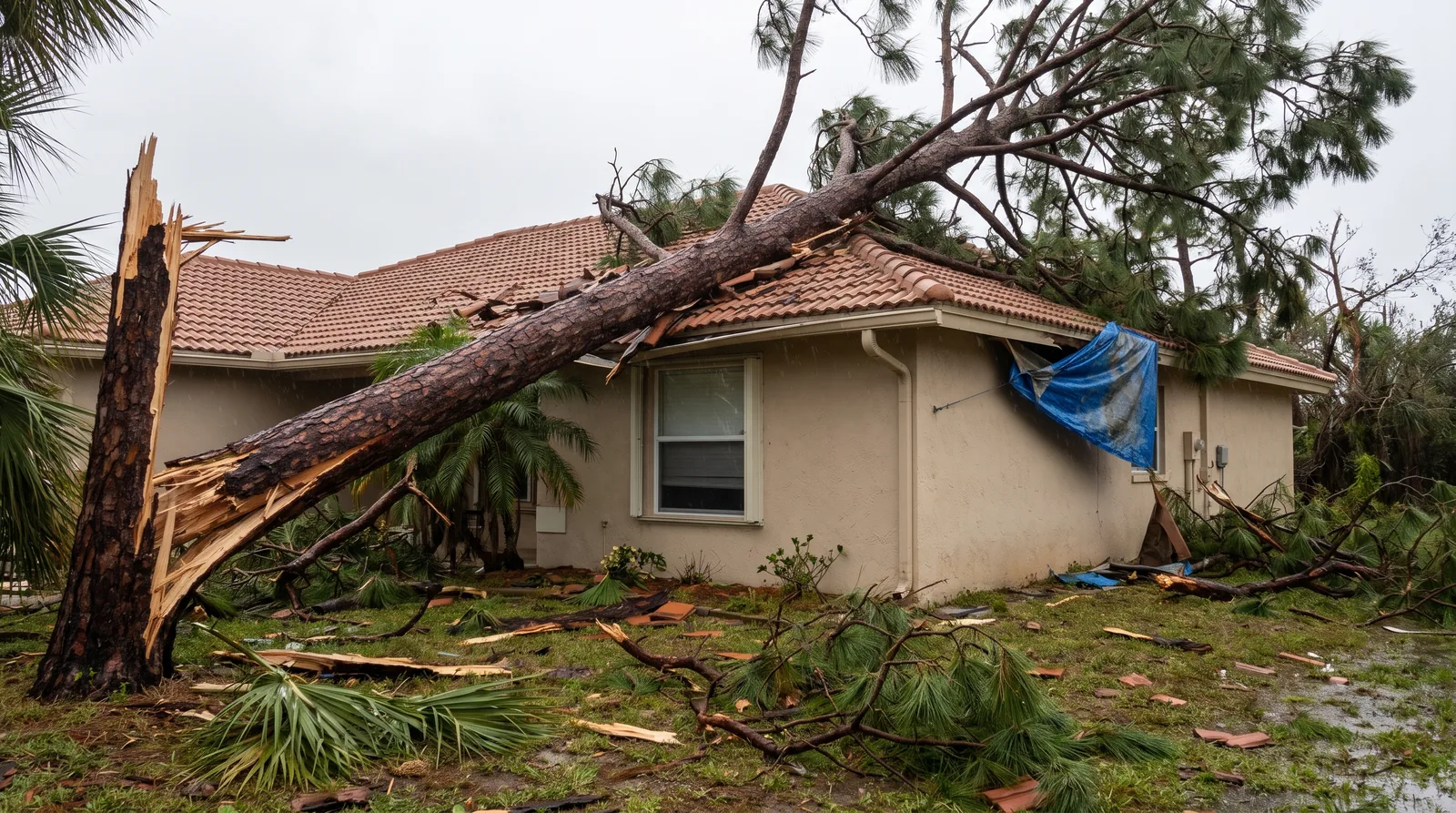
What actually fails on the Treasure Coast
After every storm, the same trees come down. Laurel and water oaks with internal decay fail at the trunk or drop major limbs. Slash pines lean and then uproot, because our sandy soil doesn't hold a tall trunk once the root plate is saturated. One-sided oaks — the ones that grew all their weight toward the open side, usually over the house — go over or shed the heavy side. Dead limbs anywhere become projectiles. And invasive Australian pines, where they still stand, are notorious for shallow-rooted, whole-tree failure. Sabal palms and healthy live oaks, by contrast, are the survivors — they bend and hold.
Thinning helps. Topping hurts.
The right pre-season work reduces the end-weight on heavy limbs and removes deadwood, so wind passes through the canopy instead of pushing against it like a sail, and there's less dead material to throw at your roof. That's real, measurable storm-proofing. Topping — cutting the canopy back to stubs — does the opposite: it forces dense, weakly attached regrowth that's more likely to break in the next storm, and it shortens the tree's life. The same goes for the palm "hurricane cut," which weakens palms rather than protecting them. UF/IFAS is clear on both: thin and reduce properly, don't top, and leave palms their green fronds.
A pre-season checklist
- Walk the yard for defects: hollows, fungus at the base, cracks, big deadwood, leaning trunks, lifted soil on the windward side of the root plate.
- Reduce end-weight on heavy, over-extended and one-sided limbs, especially over the house and the pool cage.
- Remove deadwood before it becomes a projectile.
- Clear limbs off the roof, the lanai and the house-side service drop.
- Cable weak, co-dominant unions on trees worth keeping.
- Remove the hollow laurel oak or the leaning pine that won't survive the season — before it's on the roof.
- Drop the queen-palm seed pods so they aren't flying debris.
Timing
The best window is spring, before June 1 — it gives cuts time to seal and gets you on the schedule before the whole coast calls at once. That said, honest end-weight reduction and deadwooding help even close to a storm; what doesn't help is a last-minute topping. If a tree is already a clear hazard, the smartest pre-season move is to remove it, not prep it.
Document before the season
Take dated photos of your trees now. If a healthy, well-maintained tree fails and damages a covered structure, that record helps your claim; if a tree you were warned about fails, that matters too. After a storm we photograph and itemize the damage and the work for your adjuster — but a before picture is worth having in hand.
Common questions
When should I do storm prep in Port St. Lucie?
Spring, before hurricane season starts June 1, is ideal — the tree seals its cuts and you beat the rush. We do storm-prep work right up until a storm is forecast, but the closer it gets, the less a big prune can do; near a storm, focus on removing clear hazards and dropping obvious deadwood and pods.
Does trimming really help a tree survive a hurricane?
Yes, done correctly. Thinning end-weight and removing deadwood lets wind move through the canopy instead of catching it, and removes the dead limbs that become missiles. Topping and 'hurricane-cutting' do the opposite and make failure more likely — so how it's pruned matters as much as whether it's pruned.
Which of my trees is most likely to come down?
In PSL, a laurel or water oak with internal decay, a tall slash pine with a lifting root plate, or any big tree that's grown one-sided over the house. Get those assessed first. Queen palms lose fronds and pods but rarely the whole tree; sabals and sound live oaks usually ride it out.
Is it better to remove a risky tree than prep it?
Often, yes. If a laurel oak is already hollow or a pine is leaning hard, removing it before the season is smarter and cheaper than the emergency call when it's through the roof. Prep is for sound trees; hazards should come out.
Related: Storm prep & hurricane trimming · Emergency service · Storm cleanup · Insurance guide